A .com domain name costs about $11 to $35 a year at renewal on the registrars we checked, and the first year is often cheaper. Register it in your business's name, in an account you can log into. If a renewal slips, the domain doesn't disappear that day. Your website and email can stop working within days, though. After about a month, getting the domain back costs far more than a renewal.
What a domain name costs in 2026
You pay a registrar for one year or more at a time. Part of that goes to the registry that runs the extension, and part goes to ICANN. For .com, Verisign's wholesale price is $10.26 a year and goes up to $10.97 on November 1, 2026. Namecheap's pricing page lists a $0.20 ICANN fee on each registration, renewal or transfer. Everything above that is the registrar's price.
Here's what that looks like at a few registrars, checked September 17, 2026:
| Where you buy it | First year (.com) | Renewal (.com) | Worth knowing |
|---|---|---|---|
| Porkbun | $11.08 | $11.08 | Free WHOIS privacy |
| Network Solutions | $9.99 | $34.99 | Price shown for a 1-year term |
| Squarespace | $20, or free with a yearly site plan | $20 | The free domain lasts one year |
| Cloudflare Registrar | At cost | At cost | No markup over registry and ICANN fees |
| Hostinger, with a hosting plan | Free with the Premium plan | Regular price after year one | The free domain lasts one year |
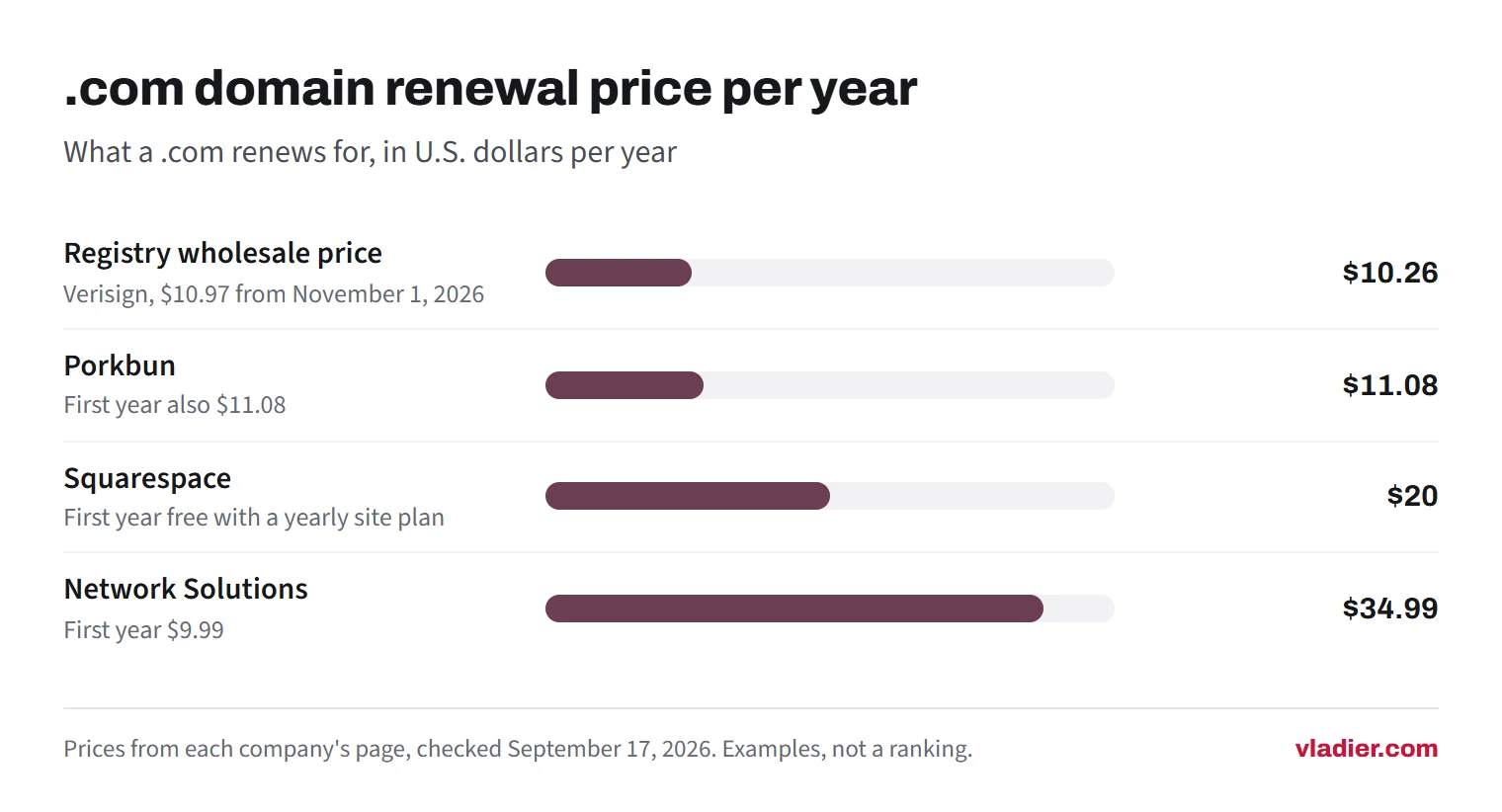
Compare the renewal column first. Over three years, a .com at Porkbun costs $33.24. At Network Solutions it costs $79.97: $9.99 for the first year, then two renewals at $34.99.
"Free domain" offers work the same way. They cover the first year, then the domain renews at the regular price. Check that price before you accept the free year.
To see the domain next to build, hosting and edit costs over three years, read how much a small business website costs.
Who should own your domain
The registrant is the person or company listed on the registration. That's who the registrar treats as the owner. Whoever holds the registrar login handles the day-to-day. When you want to move the domain, the registrar must give you a transfer code within five calendar days of your request.
So the registrant should be your business. A common problem is a domain that a web designer, a marketing company or a former employee bought for you in their own account. It works fine until the day you want to switch providers and need their cooperation.
- Registrant: your business name, not your designer's.
- Account: a login you control, with two-step sign-in turned on.
- Contact email: an address you'll still read in five years. Ideally not one on the same domain, because that email stops working if the domain lapses.
- Access for others: give your web person access to the DNS settings or a user login, not the account itself.
Order matters here. ICANN says you can't transfer a domain to another registrar within 60 days of changing the registrant name, organization or email. So fix the ownership first, and move registrars after that window.
This is also how our own plans work: you register the domain in your own account and point it at our servers. If you leave, there's nothing to hand back. For the questions to ask other website providers, see website subscription vs. buying.
How to check who owns your domain and when it expires
ICANN Lookup is free and needs no account. It runs on RDAP, which replaced WHOIS as the official source for domain registration data on January 28, 2025. Here are the steps as the tool looked on September 17, 2026:
- Go to ICANN Lookup, type your domain (for example yourcompany.com) and select Lookup.
- Under Dates, read Registry Expiration. That's the day the domain lapses if nobody renews it.
- Under Domain Status, look for clientTransferProhibited. It's a normal lock that tells the registry to reject transfers to another registrar. clientHold is a warning: it means the domain isn't active in DNS, so your site won't load. redemptionPeriod means the domain was deleted and is in its 30-day restore window.
- Note the registrar named in the results. That's the company you pay for the domain.
- Look at Contact Information. The registrant's name is probably hidden, which is normal.
- Log in at that registrar and open the domain's contact details. The registrant shown there is the owner. If nobody on your team has the login, ask that registrar's support how they verify a registrant.
Here's what our own domain showed that day. vladier.com had a created date of 2026-08-15, a registry expiration of 2027-08-15 and the status clientTransferProhibited. The registrant's name, organization and phone all read "The RDAP server redacted the value."
That redaction is expected. ICANN's Registration Data Policy took effect on August 21, 2025. Under it, a registrar may hide even the organization name if the registrant didn't agree to publish it. A public lookup confirms the dates and the registrar. Only your account shows the owner.
How often trade business domains stop working
In our research on 1,000 trade business websites (September 2026), we loaded the website address listed for each business in public map data. Of the 898 addresses we could check, 111 (12.4%) had domains that no longer resolved at all. That usually means the domain wasn't renewed or its DNS settings are broken. Another 15 (1.7%) showed a parked or for-sale page instead of the business.
The limits: we loaded each homepage once, without running JavaScript, and a listed address can be out of date. We didn't check why each domain failed. For a customer who taps that link on a map listing, it's a dead end either way. The full numbers are in our State of American Trades Websites report.
A parked page is also what an expired domain can turn into. GoDaddy parks an expired domain five days after expiration, and Porkbun may show an expiration notice or a parking page after day 10.
What happens when a domain expires, step by step
ICANN sets the minimum rules for .com and other generic extensions. Each registrar sets its exact days on top of those rules, so check your own registrar's page. The rows below mix the ICANN rules with two registrar examples.
| When | What happens |
|---|---|
| About a month and a week before | Your registrar must send at least two renewal reminders to the registrant. |
| Expiration day | The domain still exists. GoDaddy tries to auto-renew it, and you can renew at the standard price. |
| Within 5 days after | The registrar must send at least one more expiration notice. At GoDaddy, the domain is parked on day 5 and any connected website or email stops working. |
| The last 8 days you can still renew | If the registrar keeps the domain renewable for 8 days or more after expiry, it must cut off your DNS for at least the last 8 of those days. You must still be allowed to renew during that time. |
| Days 10 to 45 (Porkbun) | Porkbun's renewal grace period runs 35 to 45 days. From about day 21 the domain may go to third-party auctions. |
| Days 18 to 41 (GoDaddy) | The domain leaves your account, and recovering it costs an extra redemption fee. It's listed at auction on day 26 and goes to a final closeout auction on day 36. |
| 30 days after deletion | Every generic registry must offer a 30-day Redemption Grace Period, when the registrant can still restore the domain. At Namecheap, restoring a .com costs $88.48, redemption fee and renewal together, plus the $0.20 ICANN fee. |
| After that | The domain sits in pending delete for several days. Then the registry releases it, and anyone can register it. |
Squarespace works differently. It keeps an unpaid domain active for 15 days, then gives you 30 more days to reactivate it. After 45 days in total, the domain is released.
ICANN tells registrants to keep their contact details current, because that's where the reminders go. With an old email address on file, you never see them. Also, renewing the domain doesn't renew anything else: GoDaddy points out that website and email products need their own renewals.
A 15-minute domain check
Do this once now, then again whenever your web provider changes.
- Look up your domain on ICANN Lookup and write down the registrar and the expiry date.
- Log in at that registrar. If nobody on your team can, solve that before anything else.
- Confirm the registrant is your business and the contact email is one you check.
- Turn on auto-renew and make sure the card on file hasn't expired.
- Compare your renewal price with the table above. If it's far higher, consider moving the domain before the next renewal.
- Think about renewing for several years at once. A registration can run from 1 to 10 years.
- Put a reminder in your calendar a month before the expiry date, even with auto-renew on.
If your email runs on this domain too, business email on your own domain covers the DNS records that keep it working. To see the domain next to hosting and upkeep in a yearly budget, read website maintenance cost.
Frequently asked questions
How much does a domain name cost per year?
Can I get my domain back after it expires?
My web designer registered my domain. What should I do?
Why doesn't ICANN Lookup show my name?
Sources we checked (17)
- Porkbun: .com domain pricing (checked September 17, 2026)
- Network Solutions: Domain name registration pricing (checked September 17, 2026)
- Squarespace Help Center: Squarespace domains FAQ
- Squarespace Help Center: Free Squarespace domain offer
- Cloudflare: Registrar
- Namecheap: Domain redemption prices (checked September 17, 2026)
- Domain Name Wire: VeriSign raising wholesale .com prices (April 23, 2026)
- ICANN: Expired Registration Recovery Policy
- ICANN: FAQs for Registrants, Domain Name Renewals and Expiration
- ICANN: EPP Status Codes, What Do They Mean
- ICANN Lookup (registration data lookup tool)
- ICANN: Launching RDAP, Sunsetting WHOIS (January 27, 2025)
- ICANN: Registration Data Policy, Frequently Asked Questions (August 21, 2025)
- ICANN: FAQs for Registrants, Transferring Your Domain Name
- GoDaddy Help: Standard domain expiration timeline (checked September 17, 2026)
- Porkbun Knowledge Base: What happens after a domain expires
- Hostinger: Web hosting plans (checked September 17, 2026)
Want to see a new site before you decide anything?
We'll build your website for free and send you a private link. If you like it, plans start at $99/month. If not, you owe nothing.
Build my free website