Marketing for contractors on a small budget works in one order: cheapest first. Finish the free listings, get reviews coming in steadily, make sure someone picks up the phone, and make sure your website turns a search into a call. Paid channels come last, and only when one number says they pay. Most marketing advice for contractors is written by companies that sell retainers, and it usually opens by asking what percentage of revenue you should spend. At 1 to 10 people that is the wrong question. We build websites and nothing else, so there are no ads, no SEO packages and no leads for us to sell you here.
Marketing in cost order: what each step costs and what it does
Money is only half the cost of each row below. The other half is your time, and at your size that is the tighter budget.
| Step | Money | Your time | What it realistically does |
|---|---|---|---|
| Finish and verify your Google Business Profile | $0 | 2 to 3 hours, then 10 minutes a week | Puts you in the map results for your trade and town |
| Ask every customer for a review | $0 | 2 minutes per job | Feeds the popularity part of local ranking |
| A website you own that turns a search into a call | Varies by how you get it built | A few hours of your input, once | Gives a clicker a reason to call and a number to tap |
| Answer the phone, or plan for when you cannot | $0 to roughly $100 a month | An hour to set up | Turns everything above into actual work |
| Ask past customers and neighbors of finished jobs | $0 | An afternoon | The cheapest jobs you will book |
| Local partnerships with nearby trades | $0 | A few calls a month | Slow to start, steady once it works |
| Local Services Ads | Per lead, not per click | 3 to 4 weeks of verification first | Top placement, charged per contact |
| Google Ads search campaigns | Per click, at a budget entirely up to you | Ongoing management, yours or paid | Traffic on demand, spend on demand |
| Buying leads from a marketplace | Per lead, often sold to several contractors | Minutes to start | Fast to start, hard to make profitable |
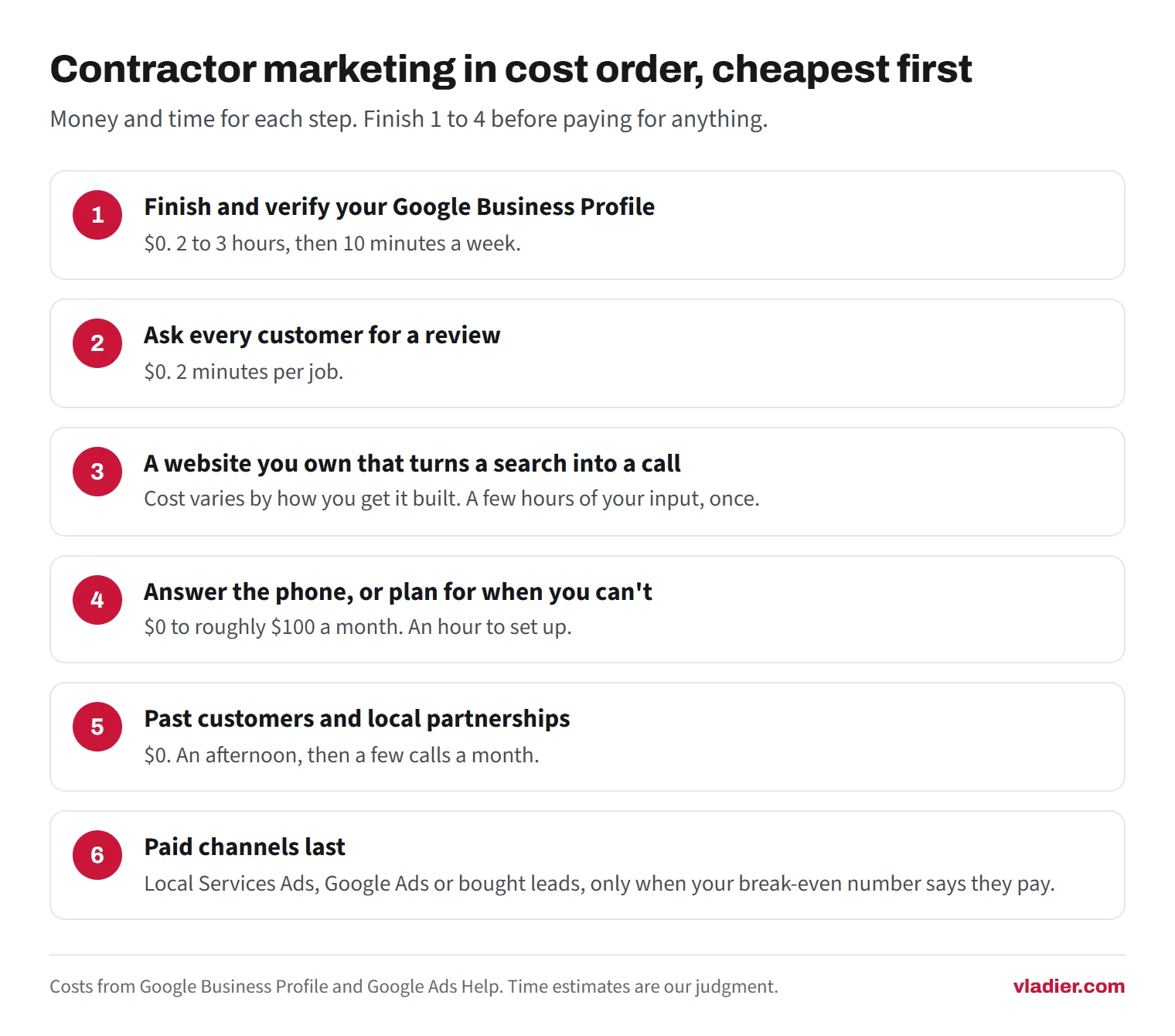
Do not start anything below row four until rows one to four are done. Paid channels multiply whatever already happens when a stranger finds you. If the profile is half built and calls roll to voicemail, they multiply a bad result and hand you the bill.
The free work, and what each piece takes
Google says you can manage how your business shows up on Maps and Search at no charge. It also says local results are based mainly on relevance, distance and popularity, and that there is no way to request or pay for a better position. There is no shortcut to buy, so these are the highest-return hours in your week.
- Google Business Profile, done properly. Verified, right primary category, service area set, hours current, photos from your own jobs. Block out one evening. Our Google Business Profile checklist has the steps in order.
- A review routine, not a review push. Send your Google review link the day the job is finished, every job, forever. Two minutes a time. Twenty reviews collected slowly beat forty in one month and nothing after.
- Answer the phone. For Local Services Ads, Google says missed calls may negatively affect your responsiveness, which feeds ad ranking. For a homeowner the effect is simpler: they call the next business on the list. If you are on a roof all day, decide what happens to that call before you spend a dollar anywhere else.
That is the whole free tier: six to eight hours of setup, then ten minutes a week.
What a website has to do before it deserves any budget
A website earns its keep in one way: someone who found you on Google, on a truck or from a friend lands on it, believes you are real, and taps the number. Everything else is optional.
Check that it works before you send anyone to it. In our research on 1,000 U.S. trade business websites (September 2026), about 1 in 5 of the website addresses listed for these businesses in public map data led nowhere useful: dead domains, error pages, sites that did not respond, or parked for-sale pages. Method and numbers are in our State of American Trades Websites report.
Open your own site on your phone now. Is the number tappable in the first screen? Does the page name the towns you cover? Are there photos of your finished work? If the answer is no three times, traffic is not your problem. Our guide on what to include on a contractor website covers the five pages that matter. Whoever builds it, keep the domain and the site in your name.
Past customers and local partnerships: the cheapest jobs you will book
Your phone is full of people who already paid you once and liked the work, and almost none of them have heard from you since. This is the first thing we would do in a slow month, and it is free.
Pull the customers from the last two or three years. Text them one at a time, in your own words. Say who you are, what you did for them, and one thing worth doing now: a furnace check before the first cold week, a repaint of the trim you did five years ago. No graphics, no newsletter, no software.
Partnerships take longer. The trades that show up in a house before or after you are your best referral source, like a remodeler for an electrician or a real estate agent for a painter. Refer work to them first, without asking for anything.
One rule covers both. The FTC's endorsement guidance says you cannot condition an incentive, a discount for example, on a review being positive, and that a customer who got a discount has to disclose it. Our guide on getting more Google reviews covers the wording.
What changes by trade: roofing, HVAC, painting, remodeling
Agencies publish a separate page for marketing for roofers, marketing for HVAC companies, marketing for painting contractors and so on. The order above is the same for all of them. What changes is when to spend, and what the customer needs to see before calling. This table is our read of those patterns, not measured data.
| Trade | Emergency or planned | Season | Repeat work | Where the first dollars go |
|---|---|---|---|---|
| Roofing | Both. Leaks and storms urgent, replacements planned | Spikes after storms | Rare. One roof per decade | Photos of finished roofs, and a clear answer on insurance claims |
| HVAC | Emergency in a heat wave or cold snap, planned for installs | Two hard peaks, two slow shoulders | High. Maintenance plans bring people back twice a year | Call answering during peaks, past-customer reminders in between |
| Plumbing | Mostly emergency | Year-round, frozen pipes in cold areas | Medium. Same house, new problem | Whatever gets the phone answered on the first ring |
| Painting | Planned. People get three quotes | Spring through fall, interiors in winter | Low to medium | Before-and-after photos, reviews that mention clean work |
| Remodeling | Planned, with months of research | Flat, long decision time | Low, but referrals are high | Project galleries and past customers. Ads convert badly on long decisions |
| Landscaping and lawn care | Planned | Heavy spring, dead winter in most states | High. Recurring contracts | Photos, and a spring push to past customers |
| Cleaning | Planned | Flat, holiday bumps | High. Weekly and biweekly routes | Reviews and referrals. One recurring customer beats many one-off leads |
Two consequences. If your work repeats, like HVAC, cleaning and lawn care, an hour on past customers beats an hour chasing new leads, because you are buying the second and third job at the same time. If your work is photo-driven, like painting, landscaping and remodeling, photograph every finished job on your phone. That is free marketing material most contractors throw away.
The break-even rule, before you pay for any advertising
One number decides whether any paid channel works for you: the most you can pay for a lead and still make money.
Most you can pay per lead = profit per job × the share of leads you book.
Use profit, not the invoice. A $600 job that costs $400 in parts and labor leaves $200. If you book 3 out of every 10 people who contact you, the most you can pay per lead is $60. Count every lead in that share, including price shoppers and wrong-area calls, because you pay for those too. If you do not know your booking rate, spend a month writing down every inquiry and what came of it. That month of counting beats the first month of ads.
Then compare the three paid options on how they charge:
- Local Services Ads charge per lead rather than per click. Google counts an answered call, a voicemail, a text or a booking request as a lead you pay for. Verification takes weeks, so this is not something you switch on during a slow week. Which leads never get credited, and how to size a bid, are in our guide to Local Services Ads.
- Google Ads search campaigns charge per click, so you also pay for people who land on your site and leave. Google says the budget is entirely up to you, but the billing catches people out: daily spend can reach twice your average daily budget, and the monthly limit is 30.4 times that daily figure. Set $30 a day expecting $600 a month and you can be billed over $900.
- Bought leads from a marketplace are usually sold to several contractors at once, so your booking rate on them runs lower than on a call from your own listing. Same formula, worse answer.
Say it out loud when it is true: paid is not worth it yet. You are booked three weeks out. Nobody answers between 8 and 5. Your profile is still unverified. Your profit per job is under about $100. In any of those four cases, buying leads costs money and teaches you nothing.
What to do with your first $500 a month
Our opinion, not a benchmark. It assumes a 1 to 10 person shop with no marketing running today, and the first two months cost almost nothing because you are building what the paid traffic has to land on.
- Month 1, about $0 and six hours. Finish and verify the Google Business Profile. Put the review link on your phone so sending it takes ten seconds. Open your website on a phone and fix the call button, the service area and the photos. Write down your profit per job and start counting inquiries.
- Month 2, $0 to about $150. Sort out the calls you are missing. In the plans we checked in September 2026, entry-level live answering ran about $99 to $300 a month and AI receptionists about $25 to $79. The low end fits this budget. Then work the past-customer list, one text at a time.
- Month 3, up to $500 in one channel. You now have a booking rate and a profit per job, so run the formula. If your number clears what leads cost in your area, start Local Services Ads or a tight Google Ads campaign on your main service and your own towns. Leave the second channel until the first one pays.
- Every month after. Measure cost per booked job, not cost per lead and not rankings. If it sits above your break-even number after six to eight weeks, turn it off and put the $500 back into reviews, photos and past customers.
With no site at all, the order is site first, ads later. Sending paid clicks to a Facebook page or a dead domain is the most expensive mistake here, and our research above suggests a dead listed address is more common than owners assume.
Where small contractors waste money
Our view, based on what gets sold hardest to trade businesses. Most digital marketing for contractors is packaged as a monthly retainer, and most of the items below turn up inside one. These are legitimate services. They are the wrong purchase at this size.
- An SEO retainer before the free profile is finished. You are paying monthly for work you could do yourself in an evening.
- A budget set as a percentage of revenue. That percentage describes how agencies price themselves. It says nothing about your break-even.
- Leads bought while calls go to voicemail. Every unanswered lead costs you twice, once on the fee and once on the job.
- Social media management for a trade nobody follows. A homeowner with a leak does not browse Instagram. Job photos belong on your profile and your site first.
- Printed mail sent outside your real service area. Cheap per piece, expensive per booked job, and impossible to measure without a dedicated number.
- Branded pens and sponsorship banners. Fine once you are profitable and want to back a local team. Not marketing at $500 a month.
- A site you cannot edit and do not own. If changing your phone number means emailing someone and waiting, you bought a problem.
Next step: open your phone, check whether your Google Business Profile says "verified," and count how many of last month's inquiries turned into jobs. Those two answers decide everything else here.
Frequently asked questions
How much should a small contractor spend on marketing?
Is Google Business Profile really free?
Local Services Ads or Google Ads first?
Can I offer a discount for a Google review?
Sources we checked (7)
- Google Business Profile Help: Get started with Google Business Profile
- Google Business Profile Help: Tips to improve your local ranking on Google
- Federal Trade Commission: The FTC's Endorsement Guides, What People Are Asking
- Google Ads Help: About average daily budgets
- Google Ads Help: Manage your spend in Google Ads
- Local Services Help: About ad rankings
- Local Services Help: How leads work
Want to see a new site before you decide anything?
We'll build your website for free and send you a private link. If you like it, plans start at $99/month. If not, you owe nothing.
Build my free website