When a negative Google review lands, reply in public within a day or two, keep it to three or four sentences, and move the details to a phone call. You can't delete a Google review yourself, and Google only takes one down when it breaks a content policy, not when it's unfair. The reply is the part you control, and it gets read by every homeowner who checks you out after that.
Your reply isn't for the person who wrote the review
It's for the homeowner reading your profile next Tuesday with two other companies open in other tabs. They see the one star, then they see how you handled it. That's the reason to reply even when you're in the right.
Google posts your reply publicly under the review, under your business name rather than your personal name, and the reviewer gets a notification. Google's own guidance says helpful replies show that you're responsive to your customers.
Replies usually go live in about 10 minutes, though Google says one can take up to 30 days. Don't post it three more times when it doesn't show.
You can edit or delete your own reply later from your profile, which is worth knowing if you wrote it hot.
How to reply to a Google review
These are Google's current steps:
- Sign in to the Google account that manages your Business Profile and open the profile. Searching your business name on Google while you're signed in usually brings it up.
- Select Read reviews.
- Next to the review you want to answer, select the reply button.
- Type your reply in the box and select Reply.
Button names are how Google shows them in September 2026. If there's no reply button, the profile probably isn't verified under your account yet, which is the first item in our Google Business Profile checklist.
Turn review alerts on so you hear about it the same day. A reply posted two months later reads like nobody was watching.
What a good reply contains
Four parts, in this order:
- Their first name. Google suggests addressing the reviewer by name and signing off with your own name or initials.
- The part that was yours, said plainly. Even if the complaint is 80% wrong, there's usually a 20% you'd do differently. Say that part. Google's advice is to acknowledge mistakes and apologize when it's appropriate.
- One correction, maximum. State the single fact that matters most, once, without repeating their version back. "The quote covered the drain line, not the fixture" beats four sentences of history.
- A phone number and a name to ask for. That moves the argument off Google and onto the phone, where you can fix it.
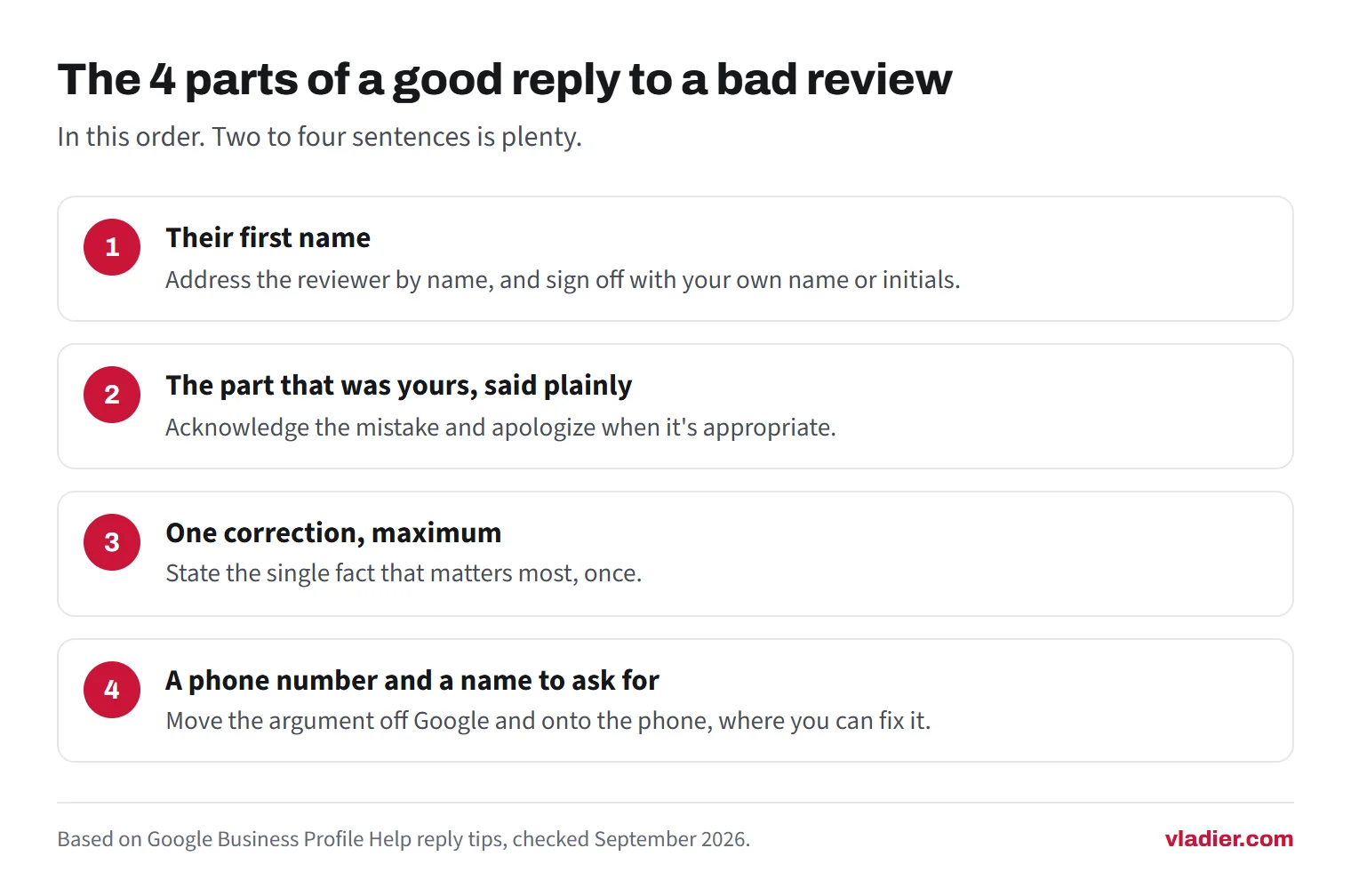
Two to four sentences is plenty. Google says to keep replies short, clear and polite, and not to use them to sell anything.
Keep the job file out of it: no address, no invoice total, nothing about what was wrong inside their house. Google tells businesses never to share a reviewer's private information, and personal information posted without consent breaks the Maps content policy on its own.
Six replies you can copy
Swap in the brackets. These are written the way an owner talks on the phone, which is how they should read.
- The bill came in over the estimate. "Hi [first name], you're right that the final number came in over the estimate, and I'm sorry it hit you as a surprise on the invoice. Once we opened up [what you found], we had to [extra work], and I should have called you before we did it. Call me at [phone] and we'll go through the line items together."
- The crew was late or didn't show. "[First name], we were [hours] late and there's no good excuse for it. The job ahead of yours ran long, and the part that's on me is that nobody from the office called to tell you. We've changed how we handle that. If you'll give us another shot, ask for [your name] at [phone]."
- The repair failed a few weeks later. "Hi [first name], I'm sorry the [repair] didn't hold. That work is covered by our [length] warranty, so there's no charge for us to come back and make it right. Call or text [phone] and I'll get you on the schedule this week."
- It looks like a different company. "Hi [first name], I think this one may have landed on the wrong business. We don't show a job at that address or on that date, and there's another [trade] company in [area] with a name close to ours. If we did work for you and I'm missing it, call me at [phone] and I'll pull the file."
- They were never a customer. "We've gone through our records and can't find this name, address or date anywhere, so we've asked Google to take a look. If you did hire us under a different name, call [phone] and I'll sort it out today."
- Abusive or clearly fake. "This review doesn't describe any job we've done, and we've reported it to Google. We're not going to argue the details here. Anyone deciding whether to call us is welcome to read the rest of these reviews, or ring [phone] and talk to me directly."
Notice what none of them do: name the customer in full, promise a refund, blame a tech by name, or demand the review be taken down.
What Google will remove, and what it won't
A review that's harsh, one-sided or just plain annoying is not a policy violation. Google's reporting page says not to report a review because you disagree with it or dislike it, and its content policy allows content that describes negative experiences in a respectful manner.
| What's in the review | Will Google remove it? |
|---|---|
| One star with no text, from a real customer | No. A rating on its own doesn't break any policy. |
| A blunt but truthful account of a real job | No. The policy allows negative experiences described respectfully. |
| "Way too expensive" after a real estimate | No. Price is part of a genuine experience. |
| From someone who was never your customer, or a made-up job | Yes, if Google agrees. Fake engagement covers content not based on a real experience. |
| A review clearly meant for a different business | Possibly. Content has to be based on an experience at that specific location. |
| A rant about politics, your truck wrap or something unrelated to the work | Possibly, as off topic. Google doesn't allow general or political commentary and personal rants. |
| Your tech's full name, a customer's address, phone or photo | Yes, if Google agrees. Personal information posted without consent isn't allowed. |
| Profanity, slurs, threats of harm | Yes, if Google agrees. That falls under harassment or hate speech. |
| Posted by a competitor, an employee or a former employee | Possibly. Google counts employment and business ties as a conflict of interest under fake engagement. |
Most bad reviews on a trade business come from real customers having a bad day, and the answer to those is a reply, not a report.
How to report a review
You can't delete a review, and neither can the tool below. You flag it and Google evaluates it. Google's current steps from your profile:
- Open your Business Profile and select Read reviews.
- Next to the review you want to flag, select Report.
- Select the reason. Pick the policy it actually breaks, not the one closest to "this is unfair."
- Select Send report.
To check where a report stands, or to handle more than one, use Google's Reviews Management Tool. Confirm your email, pick the business, choose Report a new review for removal, select Report next to the review, then pick the violation reason in the new tab and select Submit.
Google says review evaluation typically takes several days. In the tool a report shows as Decision pending, Report reviewed - no policy violation, or Escalated - check your email for updates. If Google finds no violation and you still disagree, you get one appeal per review and Google emails you the result.
Report and reply the same afternoon. Don't hold the reply while you wait, because the answer is often no. If Google does take the review down, go back and delete your reply.
Four things that make a bad review worse
- Arguing in public. Every reply you add pushes the thread further up the page and gives the reviewer something new to answer. Say your piece once, then stop, even if they reply again.
- Posting details from the job. The address, the invoice total, the photos, what the inspector said. Anyone watching reads that as a breach of trust, and personal information without consent breaks Google's policy.
- Offering money to make it disappear. Google bans offering payment, discounts, free goods or services in exchange for posting, revising or removing a negative review. It can suspend or terminate accounts over behavior that harms its users. The FTC's rule doesn't ban it outright, but the FTC says paying consumers to change or remove truthful negative reviews may violate the FTC Act. Fixing the problem is a different thing and it's allowed. The FTC says its rule doesn't stop you contacting a customer who left a negative review to sort the issue out, or asking a satisfied customer to update their review.
- Threatening to sue in the reply box. Federal rules make it unlawful to use an unfounded or groundless legal threat, a physical threat, intimidation or a public false accusation to get a review taken down. The FTC says you can threaten legal action if you have a legitimate basis for it. That's a call to a lawyer, not a line in a Google reply.
The only thing that fixes a bad average
One bad review sitting inside 40 good ones reads like one bad day. The same review inside six reads like a third of your business, and no reply changes that math.
So ask every customer, the same way, on every job. Google bans selectively soliciting positive reviews and bans incentives of any kind, which rules out the survey-first trick and the gift card. How to get more Google reviews covers where to find your review link and what to text people.
Don't have your crew or your family post a few to balance it out either. Google treats employment and personal ties as a conflict of interest under fake engagement.
Next step: open your profile today, reply to every review you skipped in the past month, then put a 10-minute review check in your calendar for every Monday. If the profile looks thin while you're in there, local SEO for contractors covers the rest of it.
Frequently asked questions
Can I get a negative Google review deleted?
Should I reply to a review I've already reported?
Can I offer a refund if the customer takes the review down?
What if the review was meant for a different company?
Sources we checked (6)
- Google Business Profile Help: Manage customer reviews
- Google Business Profile Help: Report inappropriate reviews on your Business Profile
- Google: Prohibited & restricted content, Maps User Generated Content Policy Help
- Google Business Profile Help: Tips to get more reviews (includes reply tips)
- FTC: The Consumer Reviews and Testimonials Rule, Questions and Answers
- 16 CFR 465.7: Review suppression (text via Cornell LII)
Want to see a new site before you decide anything?
We'll build your website for free and send you a private link. If you like it, plans start at $99/month. If not, you owe nothing.
Build my free website